Building Tucson: A Western Designed Around Evidence, Not Encounters
Most Western games and stories map their world around action beats – where the next shootout happens, where the chase leads, where the score gets loud. We mapped Tucson around something else entirely: where a careful listener would find the next piece of a puzzle. Every location in this world earns its place by hiding, or revealing, a specific detail. Nothing is scenery. Everything is evidence, whether the listener clocks it on the first pass or only in hindsight.
The Valley Before the Town: Teaching the Ear to Notice
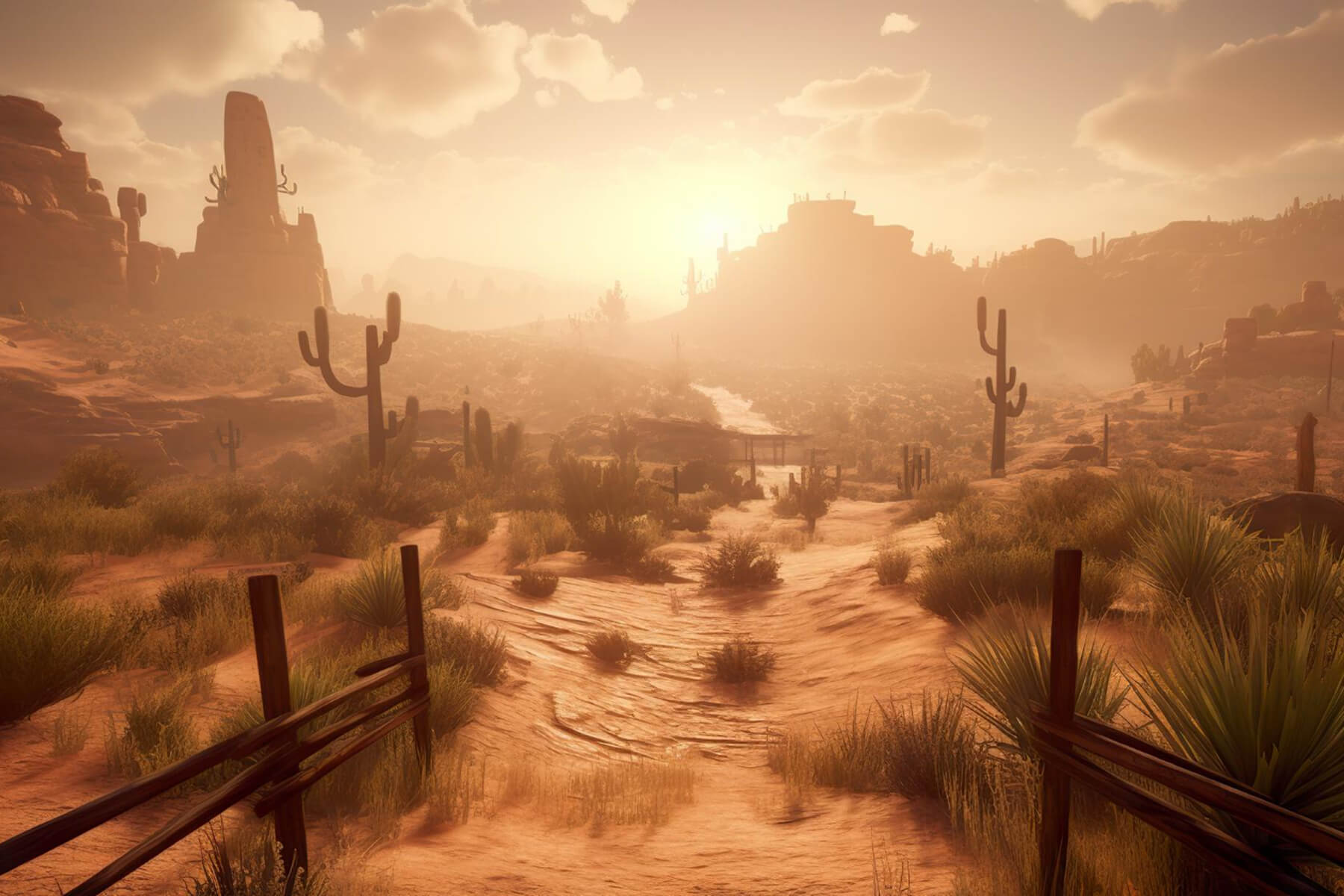
The world doesn't open in Tucson. It opens on a long, dry ride through the Valley of Despair – heat that thickens the air, a night camp where the protagonist feels watched by something that never quite resolves into a visible threat, a morning view of the valley from a ridge that's beautiful specifically because nothing about it has decided yet whether it's safe. This stretch isn't padding, even though nothing "happens" in the traditional sense. It's a deliberate training exercise for the ear: learning to register a feeling – a shift in the wind, a stillness where there should be birdsong, a shadow that disappears a half-second too fast to have been imagination – before there's any hard evidence to justify reacting to it.
By the time the protagonist crosses the old rail line, reads three sets of hoofprints heading toward town, and finally sees Tucson's rooftops catch the sunset from a distance, that skill is already installed. Everything that follows in town rewards it constantly.

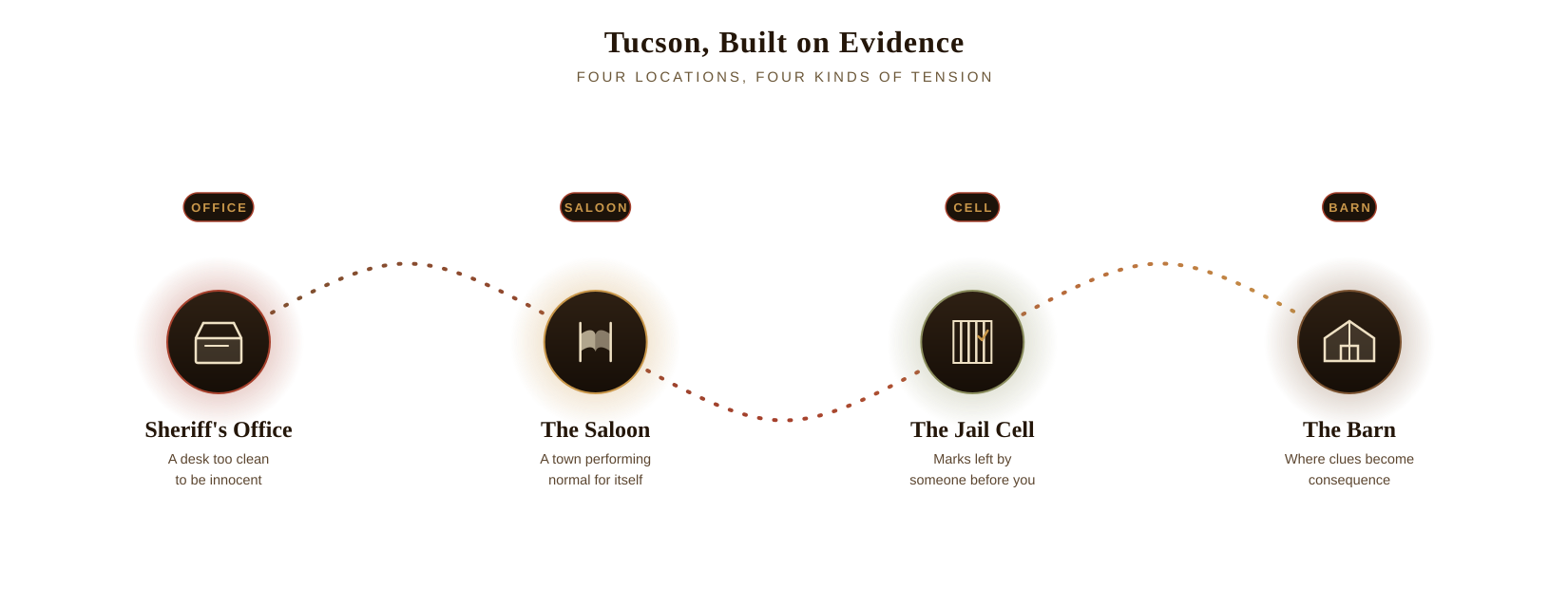
Four Locations, Four Kinds of Tension
- The sheriff's office – the investigation's home base, and the world's best lesson in reading a room instead of searching it. A desk too clean, papers stacked too evenly, a coffee ring that shouldn't be dry yet. Nothing here is dramatic. Everything here is a clue, if you're listening for it rather than waiting for it to announce itself.
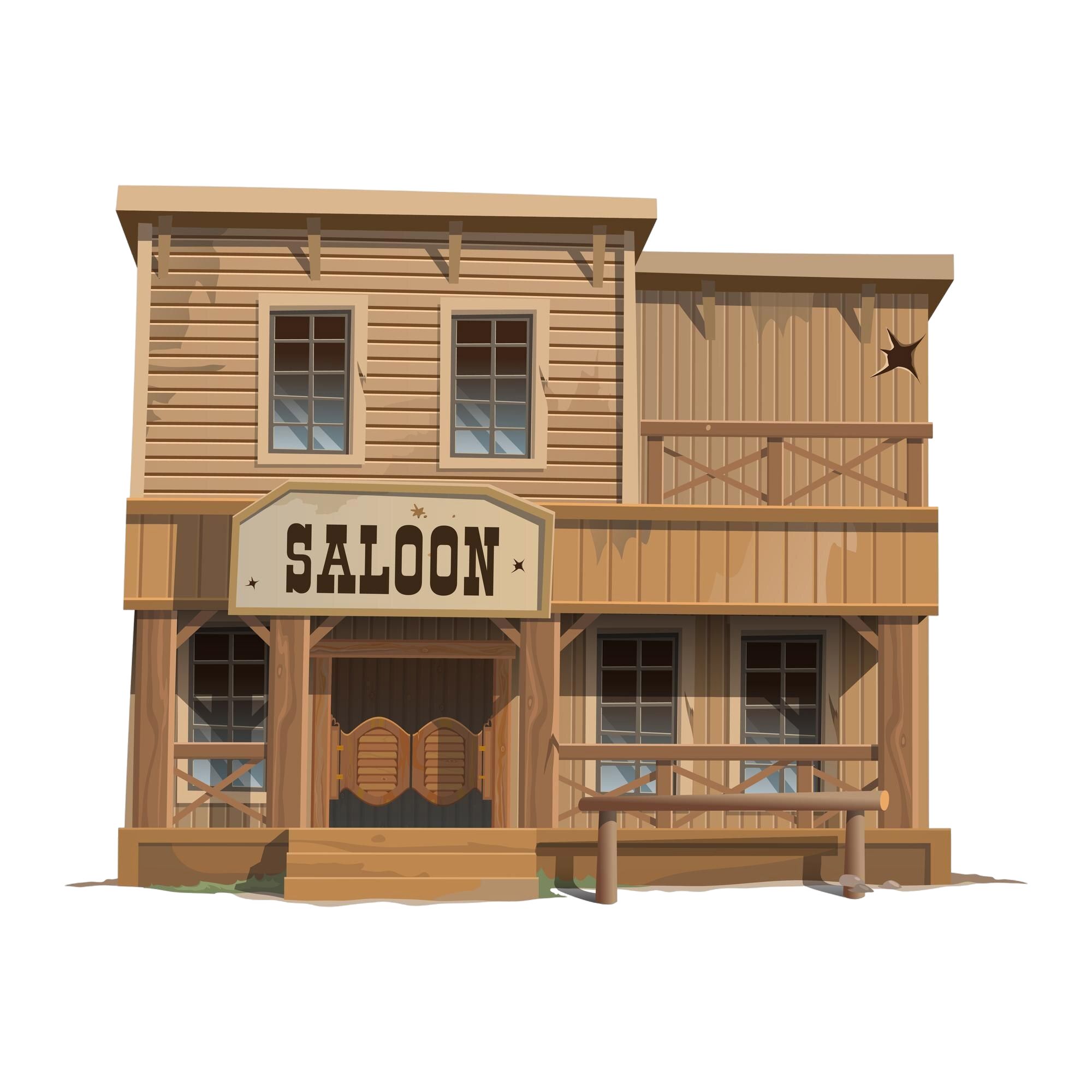
- The saloon and streets – where the town performs normalcy for itself, and for the stranger who just rode in. Laughter that's slightly too loud, conversations that stop a beat too late when the protagonist walks past, glances that hold on him just a fraction longer than a stranger warrants. This location is entirely about social tension rather than physical danger, and it's deliberately the hardest one to "solve" quickly.
- The jail cell – a small, spare space that holds one of the story's most important details: a set of scratched marks on the inside of the door, left by someone who didn't stay long, but stayed long enough to leave a warning for whoever came next.
- The hidden barn – the world's most dangerous location, and the one where investigation finally converts into consequence: crates of rifles prepared for far more than two or three men, a locked hatch in the floor, and the missing sheriff himself, held not out of cruelty but as a piece deliberately kept in reserve on someone else's board.
Designing Suspicion Instead of Combat
The source material's sheriff storyline gave us a genuinely useful structural gift in the character of Sergeant Harper: a deputy whose guilt is never stated outright, only implied, scene after scene, through composure that's just slightly too perfect for someone reacting to an actual crisis. We built the entire middle act of this world around that same technique. The listener doesn't get told who to suspect. They're given the same small, ambiguous signals the protagonist notices – a glance held too long, a story that's a little too tidy, a man who listens to instructions in a dark alley without a single word of protest – and left to draw their own conclusion.
That restraint runs all the way through the middle of the story. A late-night alley meeting between two silhouettes, a small parcel changing hands without a handshake or a word of thanks, is staged with almost no action at all – and it's one of the tensest scenes in the entire world specifically because nothing overtly criminal is said aloud. The listener has to do the work of connecting it to everything they've already noticed elsewhere: the too-clean desk, the trouble-free ledger, the name circled in pencil on a map of the county.
Escalation, Staged Like a Real Investigation
Once the story commits to its first act of open violence – a merchant shot once, cleanly, in front of the post office at dawn – the world shifts register deliberately. This isn't chaos. It's a message, and we built the scene to feel like one: no struggle, no panic in the staging, just a single precise shot and a symbol carved into the wall behind the body. The town's instinct is to blame a distant, faceless gang. The listener, by this point, has enough of their own evidence to suspect otherwise – and that gap between what the town believes and what the listener has actually pieced together is one of the most effective tools in the whole design.
A quiet scene at the well afterward, where a young witness says nothing at all but reveals everything through what she avoids looking at, was one of the hardest scenes to get right. We rewrote it several times to resist the temptation to have her simply explain what she saw. Children in this world, as in the source text, communicate through what they won't do, not through exposition.
The Hills: Designing an Ambush You Can Survive By Reading It
Tracking three sets of hoofprints out of town and into a hidden rock basin gave us the world's first real physical confrontation – a sniper's ambush from an elevated position, triggered the moment the protagonist steps into a bowl of rock that looked, just slightly, too convenient to be a coincidence. We built this encounter to be survivable specifically by paying attention beforehand: the same instinct trained back in the valley – noticing what's too quiet, too arranged, too still – pays off directly here. A note found afterward, reading only "before sunset," became the hinge the entire back half of the story turns on.
The Barn: Where the Investigation Becomes Rescue
Following a second set of tracks to an old barn on the edge of town, and finding it stocked with far more weaponry than any small operation would need, was the moment the story stopped being a mystery about a disappearance and became a race against a deadline. The rescue itself – freeing the sheriff from a locked space beneath the floorboards – was written to be quiet and quick rather than triumphant, because the story isn't over yet at that point, and we didn't want the scene to feel like an ending it isn't.
Sound Design for a Town That's Lying to You
Every scene in Tucson carries two audio layers instead of one: the ordinary sound of frontier life – hooves on packed dirt, saloon piano, creaking signage, wind through the canyon – and underneath it, a second, quieter layer that signals something the protagonist notices before he can fully name it: a pause in conversation that runs a beat too long, footsteps that stop a half-second too early, wind changing direction right before a confrontation begins. The ambush in the hills and the staged attack at sunset both work specifically because they interrupt a soundscape the listener has, by that point in the story, learned to trust as safe.
What We Left Out
Early drafts included several additional shootouts scattered through the middle act, largely to keep pace with genre expectations about how often a Western needs to fire a gun. We cut most of them. Every scene we kept had to earn its place by revealing something – a detail, a relationship, a piece of the conspiracy – rather than simply raising the stakes for their own sake. A Western can absolutely deliver real tension without a trigger being pulled, and once we trusted that fully, the story got sharper and more distinctive, not slower or less exciting.
Designing for Obsession vs. Designing for Suspicion
Tucson's entire sound and pacing model is built around suspicion – long silences, a pause held a beat too long, calm that's slightly too composed. But our source material's prospector storyline runs on a completely different emotional engine: obsession. As we start scoping that companion world, it's been useful to lay out exactly how differently the two have to be built, scene for scene:
- Pacing. Suspicion rewards stillness – the story slows down so a small detail can register. Obsession rewards momentum – a restless, forward-leaning rhythm, because gold fever by definition never lets a person sit still for long.
- Sound texture. Tucson leans on negative space – what's missing from a soundscape is often more telling than what's present. A gold rush world leans on accumulation – river current, a pan swirling, distant pickaxes, a camp that never fully goes quiet even at 2 a.m., because half the camp is too wired with hope to sleep.
- What counts as a "clue." In Tucson, a clue is a discrepancy – something that shouldn't be there. In a gold rush story, the equivalent beat is a signal – a rumor, a stranger's map, a vein of color in the pan – and the tension comes from not yet knowing if it's real.
- The emotional payoff. Tucson pays off with vindication – being proven right about a suspicion. A gold rush story pays off (or doesn't) with fortune – a fundamentally more binary, higher-variance kind of tension, closer to a gamble than a deduction.
Laying it out this way earlier in development kept us from accidentally building a second Tucson with a different hat on. The frontier is wide enough to hold both registers – it just refuses to let you build them the same way twice.
What's Next
In the final article of this series, we'll look at what actually happens to a listener moving through Tucson – the specific satisfaction of noticing a clue before it's confirmed, the discipline of staying calm under suspicion, and why a mystery you have to piece together yourself lands harder than one that's simply handed to you.