

Environmental Animation: What Moves in a World
The animation work on an Anydream world focuses not on characters or creatures but on the environment itself – the things in the world that move because physics and nature require them to move.
For Dune Desert, environmental animation covered five primary categories.
1. Vegetation Animation
Every plant in Dune Desert moves. The palm trees in the oasis sway in low wind, their fronds animated with a secondary motion that follows the movement of the larger branch. The potted plants outside shop doorways shift slightly in passing air. The dried herb bundles hanging in the bazaar stalls rock very gently with the specific frequency of objects suspended from fixed points.
Vegetation animation in Unreal Engine 5 is handled primarily through the World Position Offset (WPO) material parameter – a system that applies vertex-level displacement to geometry based on mathematical functions that simulate wind effects. For Dune Desert, a wind direction and speed value is set globally and drives the displacement of all vegetation in the scene simultaneously, ensuring that all plants respond to the same "wind" rather than moving independently and unconvincingly.
The calibration of vegetation movement requires significant iteration. Too much movement looks like a storm; too little looks like the plants are struggling against an invisible constraint. For Dune Desert, the target was the specific movement character of desert vegetation in light to moderate wind – noticeable enough to register as alive, restrained enough not to draw attention to itself.
2. Fabric and Cloth Simulation
The bazaar in Dune Desert contains a significant amount of fabric: the canopies that cover the market stalls, the hanging textiles for sale, the awnings over doorways, the cloth wrapped around goods. All of this fabric moves.
Cloth simulation in Unreal Engine 5 uses the Chaos physics engine – the same system that handles physics-based collision and destruction – to simulate the behaviour of fabric under applied forces. Each cloth asset has a set of physical properties defined: weight, stiffness, damping, and its response to the wind value set globally in the scene.
The challenge with cloth simulation is performance: high-resolution cloth physics is computationally expensive, and a bazaar with dozens of cloth elements all simulating simultaneously could cause significant performance problems. The solution is selective simulation: primary cloth elements that are visible and prominent use full physics simulation; background elements that are further from the viewer use simplified animation or fixed vertex animation that approximates the correct movement without the computational cost.
3. Particle Systems: Dust, Sand, and Atmospheric Haze
Particle systems are the primary technical tool for creating the atmospheric effects that give a world its physical character – the fine dust that moves through hot air in a desert, the sand that shifts along the ground in low wind, the heat haze that distorts the air above sunlit stone.
Anydream uses Niagara – Unreal Engine 5's particle simulation framework – for all particle effects. Niagara is a node-based visual effects system that allows precise control over the emission, behaviour, and rendering of individual particles, from systems with a few dozen particles (the smoke from a cooking fire) to systems with hundreds of thousands (a full sandstorm or heavy rain).
For Dune Desert, the primary Niagara systems include:
- Ambient dust – a persistent low-density particle system active in all zones, simulating the fine particulate matter that is always present in a desert air mass. Particles are extremely small, move slowly in a consistent direction influenced by the global wind value, and are barely perceptible individually – the effect is an imperceptible accumulation that adds atmospheric depth to the image.
- Ground-level sand movement – a directional particle system that moves fine sand particles along the ground surface in the direction of the prevailing wind. Visible primarily in the open desert zone, particularly in low-angle lighting conditions where the particles catch the light.
- Heat haze – not a particle system but a post-processing screen-space distortion effect: a subtle, slow-moving displacement of the image that simulates the refraction of light through heated air. Active in the midday lighting condition in all exterior zones, most pronounced over large flat stone surfaces.
- Fire and lantern flame – each fire source in Dune Desert (the night-time oasis fire, the lanterns in the coffee house and along the city street) has its own Niagara flame system. Flames are not looped animations but procedural simulations that vary continuously and respond to the global wind value with a slight directional lean.
- Water in the oasis – the oasis pool uses a combination of Unreal Engine's water simulation system for surface movement and a Niagara particle system for the subtle rippling effects where falling palm leaves or animal movement disturbs the surface.
4. Light Animation
Light in Dune Desert is not static. The sky progresses from pre-dawn to night across the time-of-day system. But within each lighting condition, subtle light movement adds life:
- Cloth canopy flicker – as the bazaar canopies move in wind simulation, they cast moving shadows. These shadow movements are entirely physically driven by the cloth simulation rather than being a separate effect, which means they are automatically correct.
- Flame light – the fire and lantern Niagara systems influence the scene's dynamic lighting. The Unreal Engine light sources attached to flame emitters inherit the movement of the particle simulation, producing the characteristic flicker of firelight on stone surfaces.
- Caustics on the oasis – the movement of the water surface produces animated light caustics on the stones at the shallow edge of the pool and on the lower trunks of the surrounding palms.
5. Sky and Cloud Animation
The sky in Dune Desert is not a static HDR image but a dynamic simulation using Unreal Engine 5's Sky Atmosphere and Volumetric Clouds systems. Clouds move slowly across the sky, driven by the same wind value that drives vegetation and particle systems. Their movement produces gradual changes in light quality as they partially obscure the sun – not a dramatic effect, but a subtle, ongoing variation that prevents the lighting from feeling frozen.
The Sky Atmosphere system simulates the physical scattering of light through the atmosphere, which is why the sky in Dune Desert is not uniformly blue but has the specific gradient from pale horizon to deep blue zenith that characterises clear desert sky. This atmospheric simulation also produces the correct colours at dawn and dusk – the specific band of orange and red near the horizon at sunset is not painted in but is the physically accurate result of the sun's light passing through more atmosphere at low angles.

Testing: The Phase That Cannot Be Skipped
With animation and environmental effects complete, the world moves into the testing phase. Testing is the least visually exciting part of the production process and the most consequential.
A world that fails technically – that crashes, stutters, renders incorrectly on certain hardware configurations, or produces audio artefacts in specific listening conditions – is not an experience. It is a broken promise. The investment in visual quality, sound design, and production rigour is worthless if the experience fails to run.
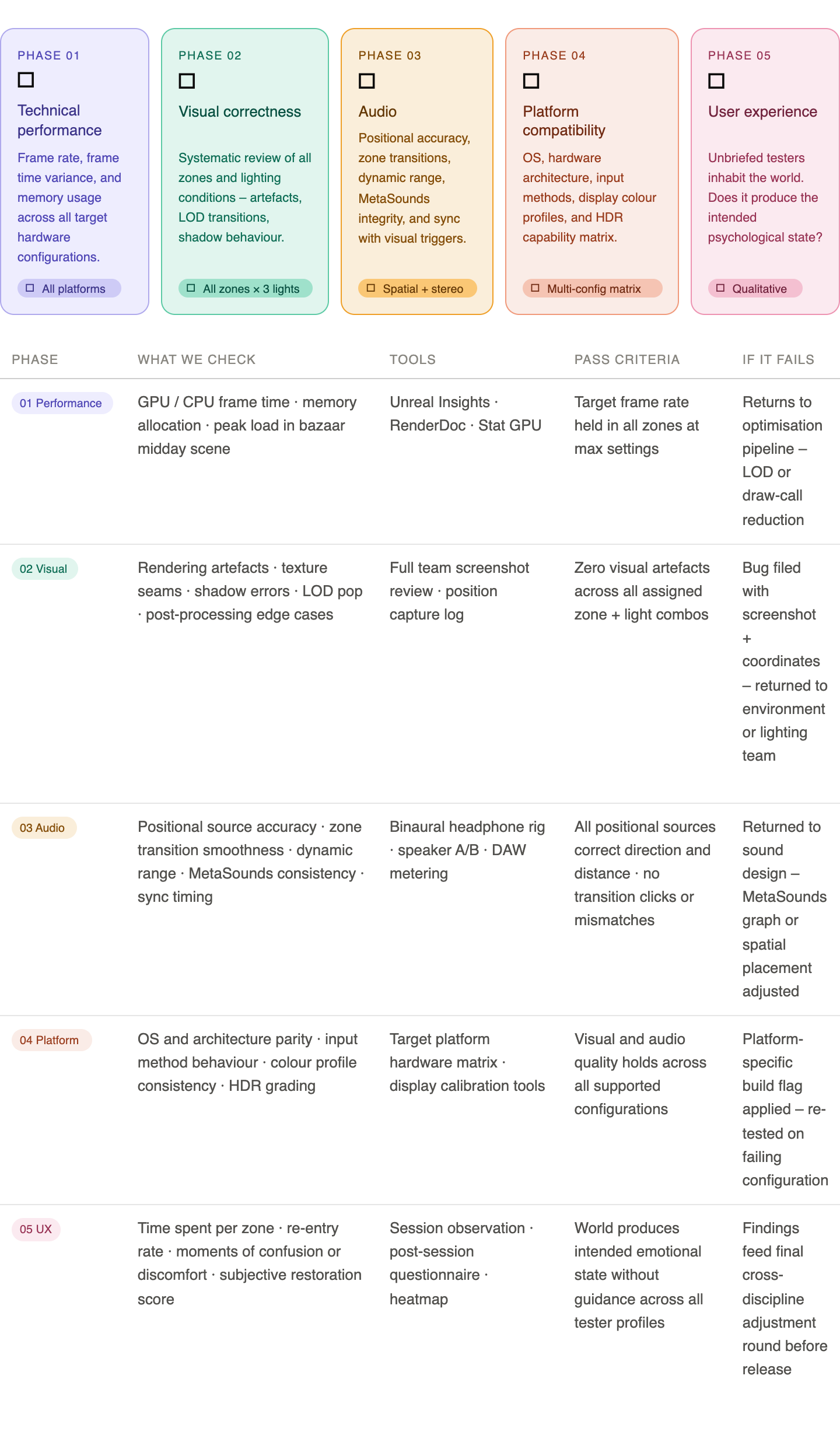
Testing at Anydream covers five distinct areas.
Technical Performance Testing
The first testing priority is raw performance: frame rate, frame time consistency, and memory usage across the full range of target hardware configurations.
Performance testing involves running the complete world, with all effects active, on a matrix of hardware configurations that represents the range of devices the experience will run on. Each configuration is tested across all zones and all lighting conditions, with performance data captured and analysed.
Performance budgets are defined before testing begins: minimum acceptable frame rates per platform, maximum acceptable frame time variance, maximum memory allocation. Any area of the world that fails to meet these budgets returns to the optimisation pipeline for further work.
For Dune Desert, the most demanding configuration is the bazaar at midday with full cloth simulation active and maximum view distance. This configuration sets the performance ceiling that all other optimisation work is calibrated to.
Visual Correctness Testing
Visual correctness testing is the systematic review of the world's appearance across all zones, all lighting conditions, and all positions within each zone. Its purpose is to identify:
- Visual artefacts – rendering errors, texture seams, geometry clipping, incorrect shadow behaviour, reflection errors
- Lighting inconsistencies – areas where the lighting behaviour differs from the design intent
- LOD (Level of Detail) transitions – moments where assets visibly simplify as the viewer moves closer or further from them
- Post-processing edge cases – conditions under which the colour grading, bloom, or other post-processing effects produce unintended results
Visual correctness testing is conducted by the full production team, with each member reviewing specific assigned zones and lighting conditions and documenting findings with screenshots and position data.
Audio Testing
Audio testing covers the full spatial audio system under all viewing conditions:
- Positional accuracy – confirming that all positional audio sources (wildlife, specific objects, spatial ambient elements) sound from the correct direction and distance across the full range of positions within each zone
- Zone transition audio – confirming that the audio transitions between zones are smooth and correctly timed
- Dynamic range and balance – confirming that the audio mix holds up across different listening environments: high-quality headphones, standard earbuds, laptop speakers
- MetaSounds system integrity – confirming that procedural audio systems (wind, dynamic ambient layering) behave correctly and consistently
- Synchronisation – confirming that audio events triggered by visual conditions (time-of-day transitions, proximity to specific elements) fire at the correct moment
Platform Compatibility Testing
Anydream worlds are designed to run across multiple platforms and access methods. Platform compatibility testing confirms that the experience runs correctly on all supported configurations – different operating systems, different hardware architectures, different input methods.
Platform testing also covers display compatibility: different screen sizes, different colour profiles, different HDR capabilities. The colour grading that looks correct on a calibrated display needs to look acceptable on an uncalibrated consumer monitor. The post-processing values are adjusted to find a calibration that holds up across the widest possible range of display conditions.

User Experience Testing
The final testing phase is the most subjective but in some ways the most important: having people who have not been involved in the production of the world experience it, without briefing or guidance, and observing what happens.
User experience testing answers questions that technical testing cannot:
- Does the world feel like the emotional target specified in the World Script?
- Do users understand intuitively how to inhabit the space?
- Are there moments that feel confusing, uncomfortable, or contrary to the intended experience?
- How long do users spend in the world, and where do they spend the most time?
- Does the experience produce the psychological state – genuine rest, presence, restoration – that it was designed to produce?
The results of user experience testing feed back into a final round of adjustments across every production discipline. A lighting value might shift. A sound level might change. A particle effect might be reduced. The specific framing of the initial view when entering the world might be adjusted.
These final adjustments – small individually, significant in aggregate – are what close the gap between a world that is technically complete and a world that is ready.