

Every world begins the same way: with a feeling
Every world begins the same way: with a feeling.
Not a location, or visual reference. Not even a narrative, but feeling – something difficult to name but immediately recognizable when you encounter it. The heat of sand under a noon sun. The particular stillness of a desert at three in the morning when every star is out and nothing moves. The smell of spices and dust on a stone-paved market street where a hundred voices overlap and not one of them is speaking your language.
That feeling is what we are trying to build at Anydream. And building it correctly – in a way that works on the nervous system rather than just the eyes – begins long before any visual work starts.
Why We Start With a Document, Not a Mood Board
The first instinct when creating an immersive world is usually to collect beautiful images. A mood board feels like the natural place to begin. But we've learned that visuals alone don't create worlds – they decorate them.
Every memorable world starts with a story.
Before thinking about colors, architecture, or costumes, we need to understand what is happening in this world. Who lives there? What drives the characters? What emotions should the audience experience? What happened before the first scene begins? These questions shape the narrative, and the narrative shapes everything else.
The filmmakers and game studios we admire follow the same philosophy. Before a single frame of Dune was designed, Denis Villeneuve and production designer Patrice Vermette spent months immersing themselves in Dune, studying its themes, history, and emotional language. The references they collected weren't meant to imitate reality – they were tools for understanding the feeling the world should evoke. The visuals emerged from the story.
The team behind Assassin's Creed: Origins approached their world in much the same way. Years of historical research, conversations with archaeologists and Egyptologists, and countless books came long before concept art. Their goal wasn't simply to recreate Ancient Egypt – it was to understand how people lived, believed, feared, and dreamed. Only then could they build a world that felt authentic.
At Anydream, we begin exactly the same way.
Before creating a single image, we write a document.
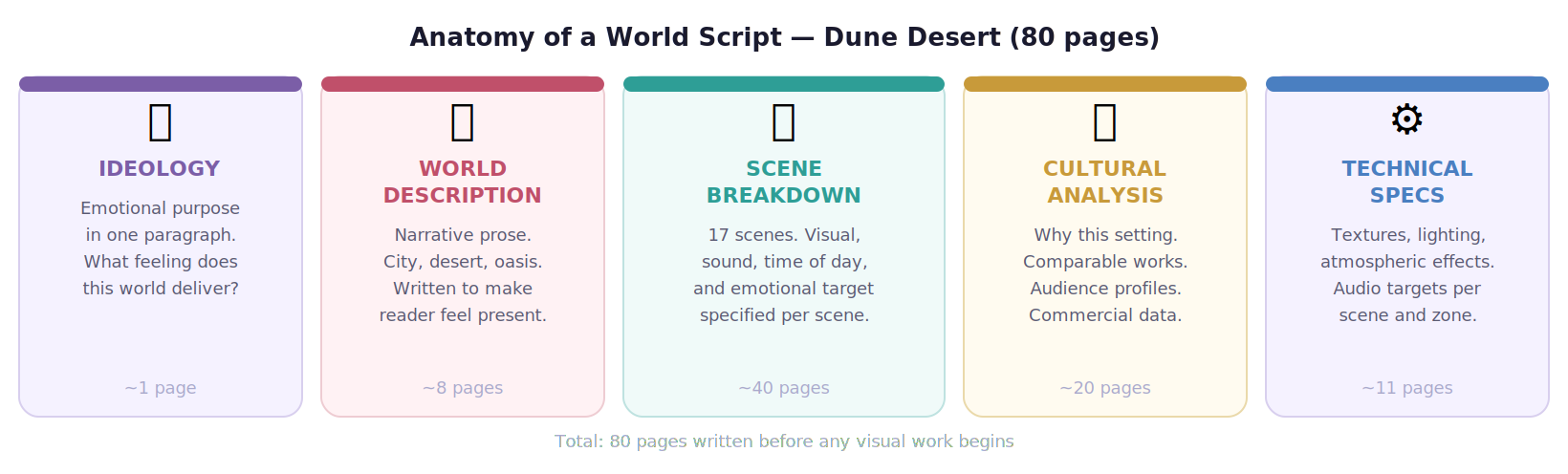
It's not a mood board – it's a screenplay for the world. Usually between 30 and 80 pages, it defines the narrative, the characters, the relationships, the rules of the universe, its history, atmosphere, conflicts, and emotional tone. It answers one simple question: what story are we actually telling?
Once that story exists, every visual decision becomes obvious. Locations, lighting, fashion, architecture, props, and color palettes are no longer isolated design choices – they become expressions of the narrative.
Because beautiful images can capture attention. But only a compelling story can make a world feel real.
Our First World: Dune Desert
The first Anydream world we built is called Dune Desert. Before we describe how it was made, it's worth describing what it is, because the idea behind it is inseparable from the process that created it.
Dune Desert is not a game. It is not a narrative. It is an immersive cinematic environment built around the sensory and emotional experience of a desert civilization at its peak – the mystery, the heat, the scale, the particular mix of danger and beauty that makes desert cultures some of the most compelling human settings ever created.
The world is inspired by the intersection of several ancient Eastern civilizations: the Arabian Peninsula, Persia, Mesopotamia, and the trade routes that connected them. It contains a walled city with its bazaars, spices, stone streets, and the low hum of a hundred simultaneous lives. Beyond the walls, the desert – vast, silent, and magnificent.
The first question we asked ourselves was: why does this setting have such enduring cultural pull?
The Research Phase: Why Does the Desert Work?
Before building anything, we study. This phase is the longest and most important part of the process, and it informs everything that comes after.
For Dune Desert, our research covered five distinct areas.
1. Cultural and Historical Sources
Ancient Eastern civilizations – Egypt, Persia, Mesopotamia, Arabia, India – represent some of the richest source material in human history. We studied not just the visual record but the philosophical and social structures underneath it: how trade shaped architecture, how religion shaped public space, how scarcity shaped the relationship between people and landscape.
Key primary sources included:
– "One Thousand and One Nights" (Arabian Nights): The original source text – not Disney's interpretation of it, but the original Arabic compilation – contains descriptions of markets, spaces, sounds, and social dynamics that remain extraordinarily vivid. The way the bazaar functions as the emotional center of urban life in these stories directly shaped our world design.
– Jean-Claude Golvin's historical illustrations of the ancient world: The French archaeologist and illustrator has produced thousands of reconstructions of ancient cities from the Egyptian, Persian, and Mesopotamian worlds. These became key reference materials, for the same reason they became key reference materials for Ubisoft's Assassin's Creed: Origins team – they represent the most rigorous available visualization of how these spaces actually looked and felt.
2. Film and Visual References
Cinema provided essential emotional reference points – not for copying, but for understanding how the best filmmakers in history have approached the emotional challenge of making audiences feel present in a desert world.
Our primary film references:
– Dune: Part One (2021) and Dune: Part Two (2024), directed by Denis Villeneuve
– Lawrence of Arabia (1962), directed by David Lean
– Aladdin (1992, Disney animation)
– Prince of Persia: The Sands of Time (2010)
3. Games as Research
Most significantly: Assassin's Creed: Origins (Ubisoft, 2017)
We also studied Journey (thatgamecompany, 2012), Shadow of the Tomb Raider, and The Elder Scrolls series.
4. Music and Sound Research
Sound is not secondary in our worlds – it is co-primary with the visual.
We studied traditional instruments: the oud, the tabla, the ney flute, the riq frame drum.
We also studied Hans Zimmer's score for Dune: Part One.
5. Psychological and Behavioral Research
We asked: what does a desert environment actually do to the human mind?
Desert environments consistently produce measurable psychological effects: reduced anxiety, expanded sense of scale and perspective, quieting of the default mode network, and an increase in "awe".
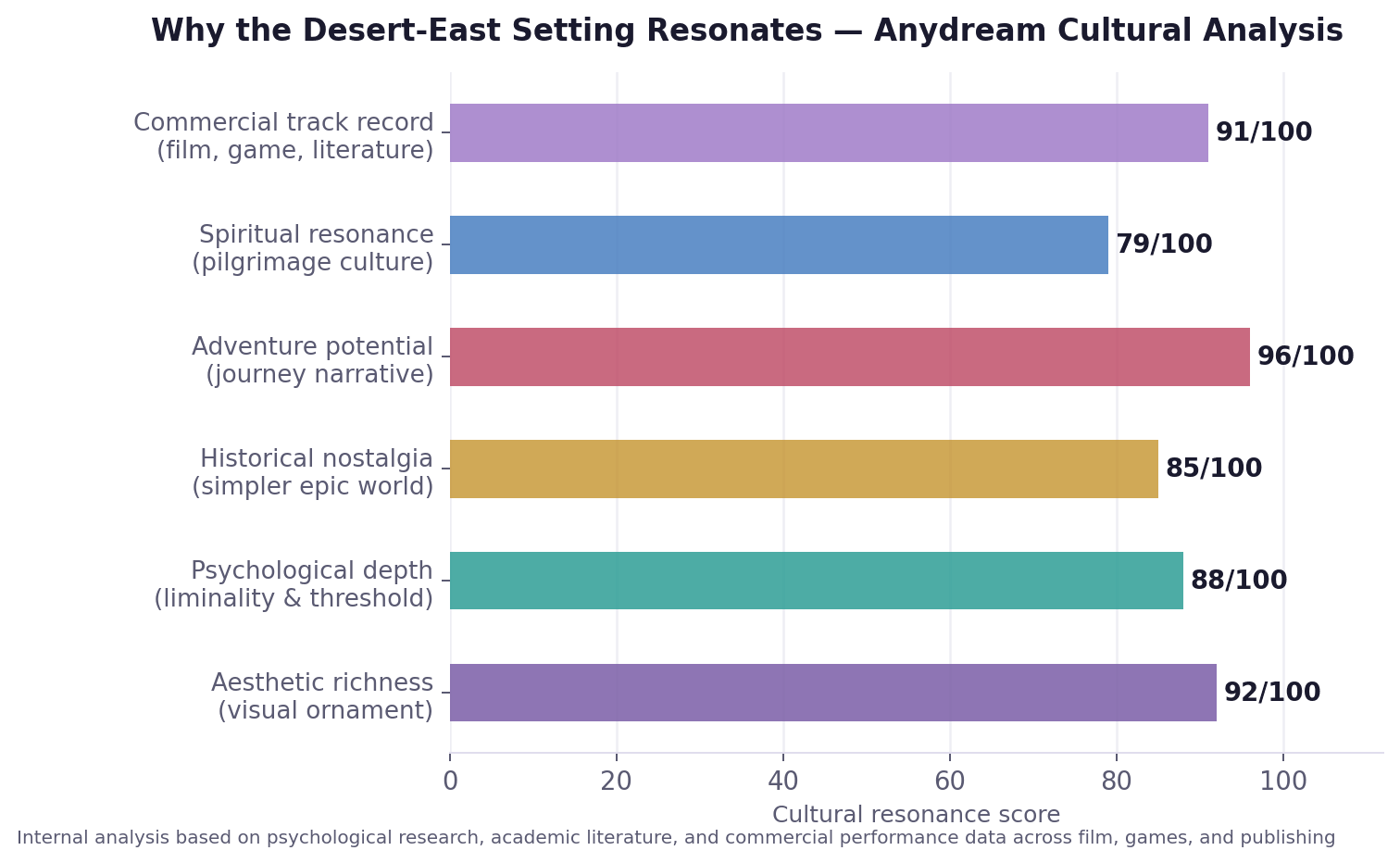
Why the Desert and Eastern Civilization? A Cultural Analysis
The setting functions on multiple psychological registers simultaneously:
1. Aesthetic register:
The visual richness of Eastern architecture, textiles, and ornament creates a density of visual information that rewards attention.
2. Psychological register:
Desert civilizations are historically associated with the threshold between worlds.
3. Nostalgia register:
Ancient settings trigger "historical nostalgia".
4. Adventure register:
Desert landscapes offer the oldest narrative structure in human storytelling – the journey.
What the World Script Actually Contains
- The World Ideology
- World Description
- Scene-by-Scene Breakdown
- Cultural Analysis
- Technical Requirements
- Audience Profiles
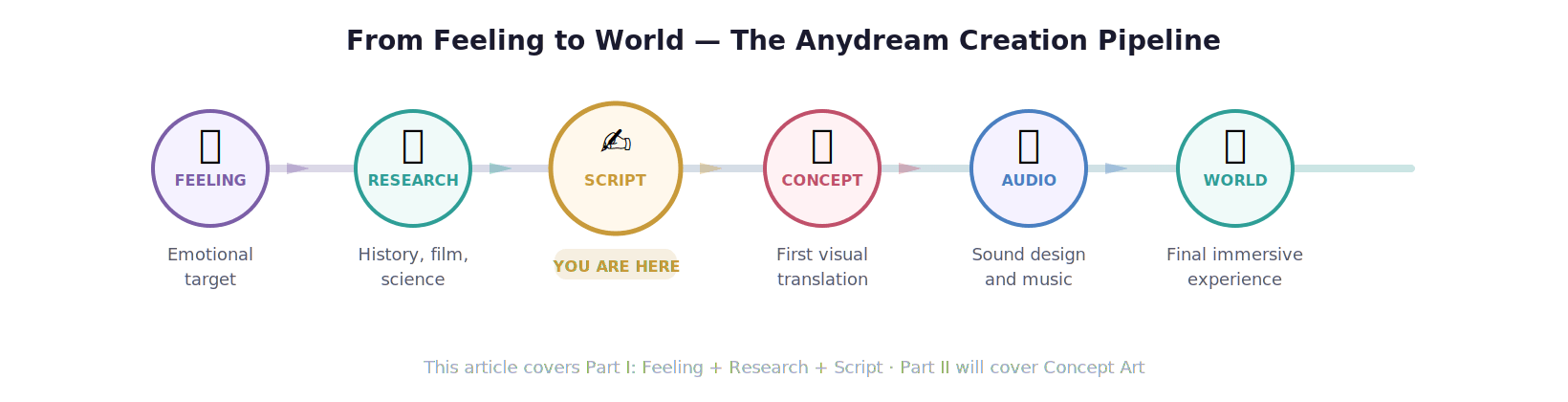
This Is Only the Beginning
The World Script is Part I of a process that spans six stages – from research and writing through concept art, environment design, audio production, testing, and final build. Each stage has its own discipline and its own logic. What matters about the script stage is this: everything that follows is only as good as the foundation it is built on. Dune Desert took months to research before a single piece of visual work began. We think that investment is visible in the final experience.
And in the meantime – the world is waiting for you.