
Most People Will Never See the World?
Ask most people what they would do if money and time were not an obstacle, and travel comes up almost immediately. Kyoto in cherry blossom season. The coast of Amalfi at sunset. The markets of Marrakech. The temples of Angkor Wat. It is not just leisure they are describing – it is the feeling of being somewhere completely different, immersed in a world that is not their own.
That feeling is among the most powerfully restorative experiences available to human beings. Neuroscience confirms what travelers have always known intuitively: encountering new environments expands perspective, reduces anxiety, stimulates creativity, and fundamentally shifts how we relate to ourselves and others.
And yet – for the overwhelming majority of people on this planet – that experience remains entirely out of reach.
Not because they don't want it. Because the world has not been built to let them have it.
The Numbers Are Stark
The global travel gap is larger than most people realize. Consider the following:
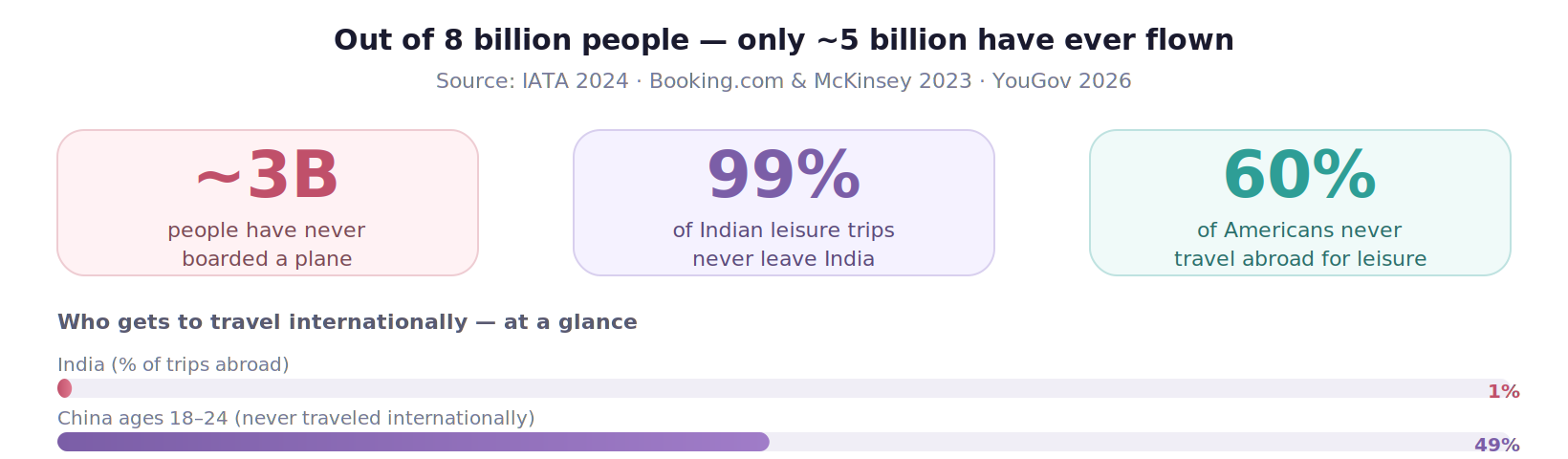
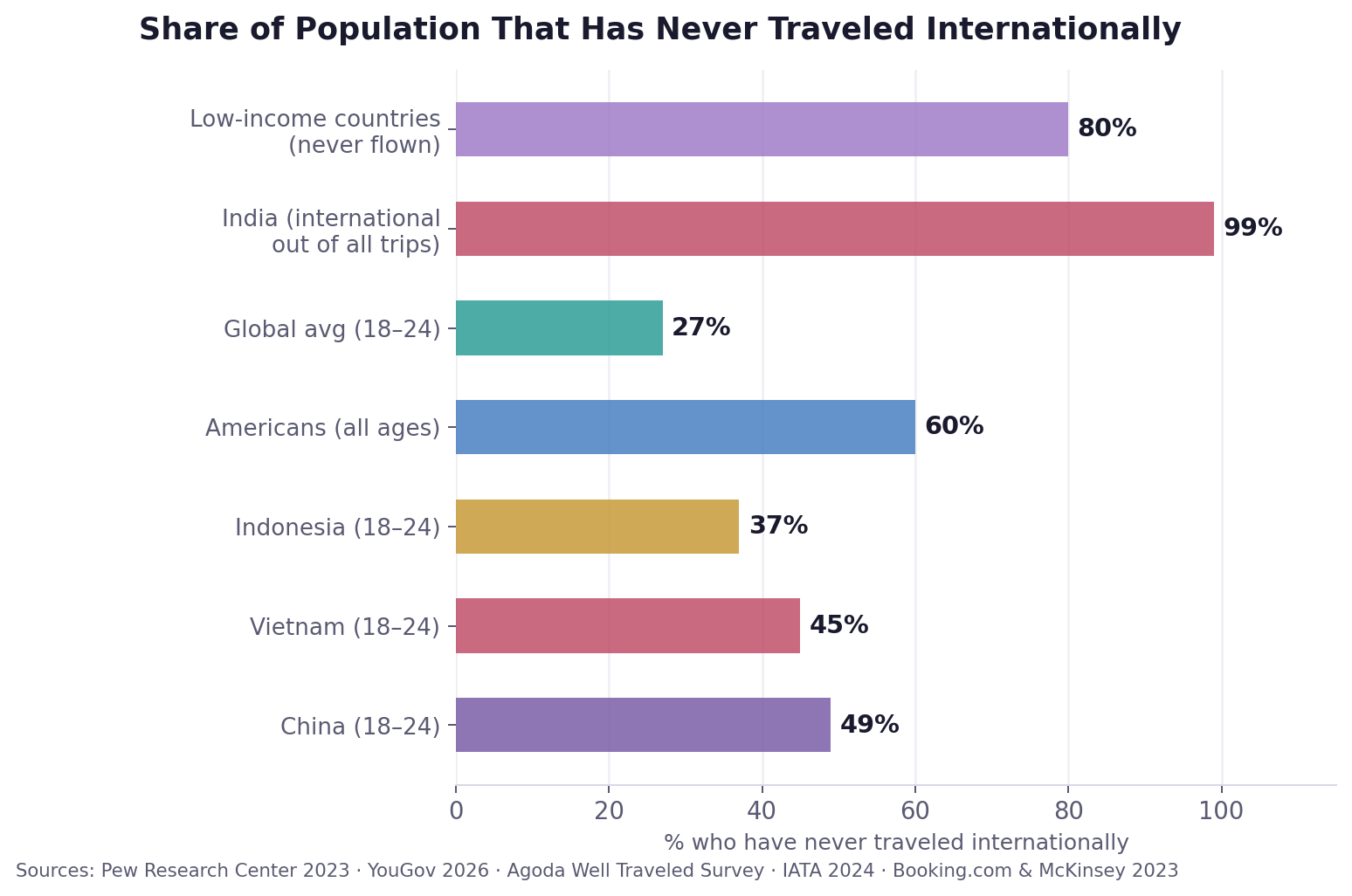
1. 60% of Americans say they never travel abroad for leisure, and the US is considered a high-income country. (YouGov, 2026)
2. In India – a nation of 1.4 billion – 99% of all leisure trips taken in 2022 were domestic. Only 1% crossed a border. (Booking.com & McKinsey, 2023)
3. In China and Vietnam, 49% of adults aged 18–24 have never traveled internationally at all. (Agoda Well Traveled Survey)
4. Only about 5 billion unique individuals have ever boarded a plane – out of 8 billion people on Earth. (IATA, 2024)
5. In low-income countries, most people have never flown in their entire lives. (IATA)
6. The average international trip costs $3,500–$5,000 for a family of four – a figure that exceeds the annual income of hundreds of millions of people worldwide.
Three Walls That Keep the World Divided
Travel inequality is not random. It is the product of three deeply structural barriers that reinforce each other in ways that make the problem remarkably durable.
The First Wall: Money
Travel is expensive, and getting more so. The average cost of an international flight has risen sharply in recent years, driven by fuel prices, reduced competition, and post-pandemic demand recovery. When you add accommodation, food, insurance, and local transport, a week-long international trip easily reaches $2,000–$4,000 per person.
For context: the median daily wage in India is approximately $8. In Indonesia, it is under $6. For a family in these countries, a single international vacation represents years of savings, not a discretionary purchase, but an impossibility.
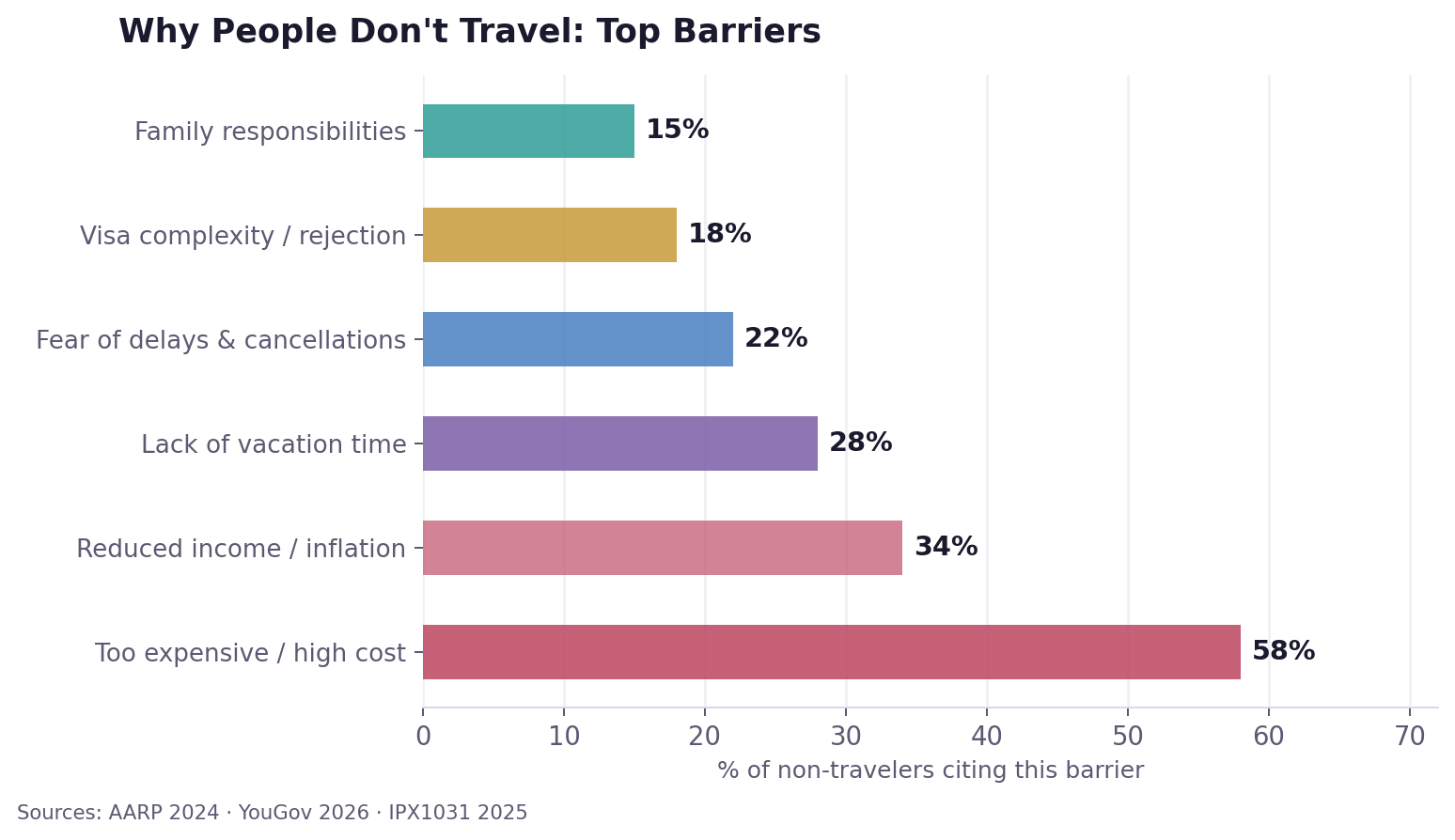
Even in wealthier nations, cost is the dominant barrier. When Americans explain why they don't travel, 51% cite high cost as the primary reason, and 34% point to decreased discretionary income due to inflation. (AARP, 2024)

The Second Wall: Visas
The world is not equally open to everyone. A British passport grants visa-free access to 190+ countries. An Afghan passport grants access to 28. This is not a minor inconvenience – it is a fundamental inequality baked into the global system.
For millions of people in Asia, Africa, and South America, applying for a Schengen visa to visit Europe involves months of preparation, significant fees, extensive documentation, and a meaningful risk of rejection. In 2023, African applicants faced a 27% Schengen visa rejection rate – more than double the global average. For some individual countries, the rate exceeded 45%. (Henley & Partners, 2025)
Even in India – the world's most populous country – the visa process to visit major Western nations is described by travelers as humiliating: months of waiting, demands for bank statements, invitation letters, and rejections offered without explanation. (Adventure.com, 2024)
The Third Wall: Time
Even when money and documentation are in order, travel requires time – a resource that is itself distributed profoundly unequally. In countries where workers receive few or no guaranteed vacation days, where gig economy employment offers no paid leave, and where family obligations leave no room for extended absence, a two-week international trip is simply not an option regardless of finances.
A Closer Look at Asia
Asia contains more than half of the world's population, and some of the most striking travel inequality data on the planet.
India
India's 1.4 billion people took 1.7 billion leisure trips in 2022. The appetite for travel is enormous. But 99% of those trips stayed within India's borders. The reasons are familiar: cost, visa complexity, and the sheer logistical difficulty of international travel for working-class and middle-class families. McKinsey projects that even by 2030, with India becoming the world's fourth largest travel spending nation, 99% of leisure trips will still be domestic.
China
China's outbound travel has recovered strongly post-pandemic, but remains concentrated in a relatively small urban middle and upper class. Nearly half of Chinese adults aged 18–24 have never traveled internationally, and among older, lower-income demographics, that figure is almost certainly higher. International travel in China remains a marker of economic status, not a broadly accessible experience.
Vietnam & Indonesia
In Vietnam, 45% of adults aged 18–24 have never traveled internationally. In Indonesia, the figure is 37%. These are not countries without culture, curiosity, or desire – they are countries where the structural barriers to international movement are simply too high for the majority of the population to overcome.
Why This Matters Beyond Tourism
The inability to travel is not just an inconvenience. It has measurable consequences for mental health, empathy, and quality of life.
Extensive research confirms that exposure to new environments – different cultures, landscapes, sounds, foods, rhythms of life – produces lasting positive effects on psychological wellbeing. Travel reduces stress hormones, promotes openness and emotional flexibility, and creates the kind of perspective shift that is difficult to achieve through any other means. It reminds people that the world is larger than their daily circumstances. That other ways of living are possible. That the life they know is one of many.
When that experience is structurally unavailable – when it belongs to a class of people, or a type of passport, rather than to the human species as a whole – something important is lost. Not just for individuals, but collectively.
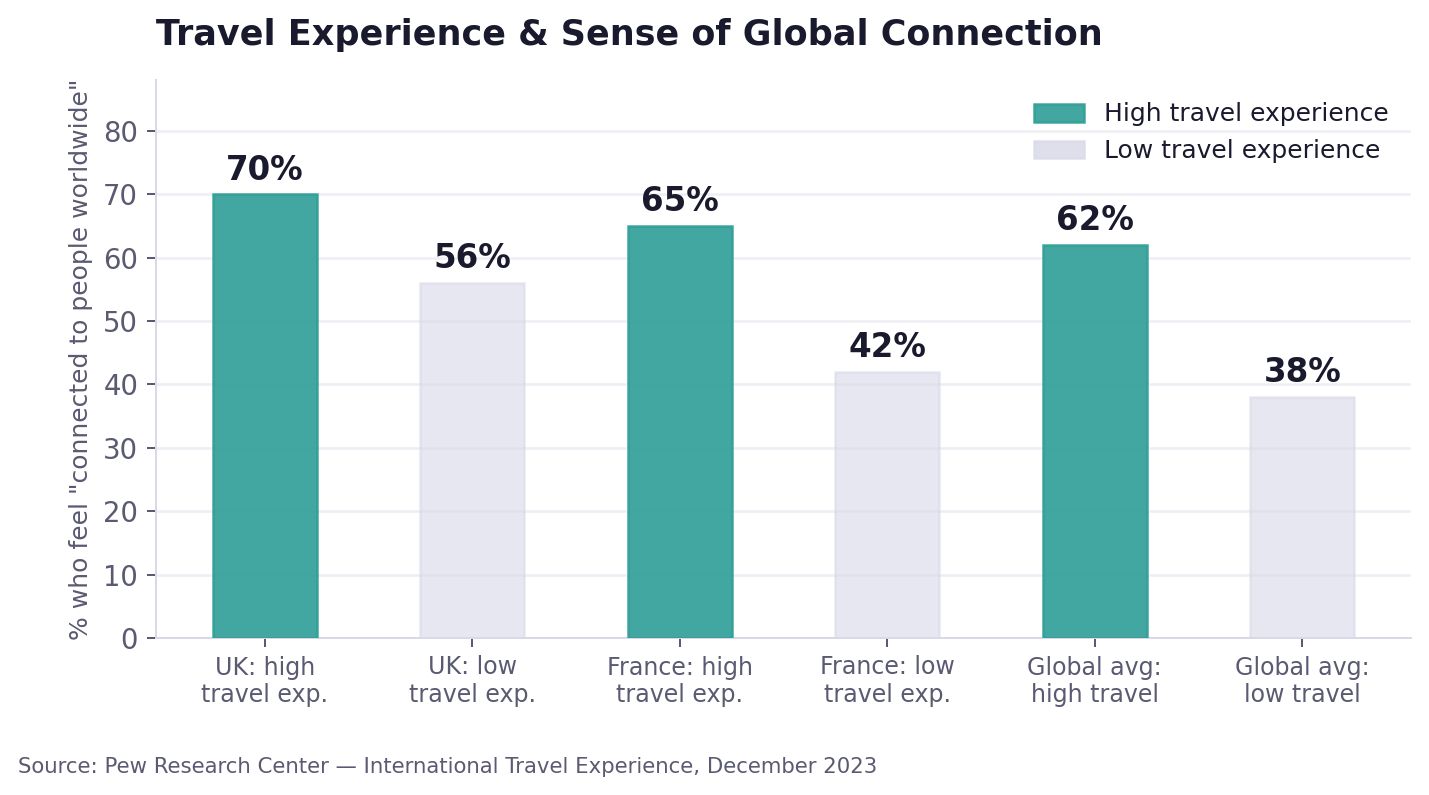
People who have traveled are, on average, more empathetic, more globally aware, and more connected to the sense that humanity shares a common story. The data from Pew Research confirms this directly: people with more international travel experience are significantly more likely to feel a sense of connection with people around the world.
A world where only the wealthy few can access that experience is a world with a narrower, more divided version of that feeling.
Why We Built Anydream
We do not believe that the transformative experience of being somewhere else – truly, sensorially, emotionally elsewhere, should be gated by passport color, bank account size, or the outcome of a visa application.
We believe in access. In the idea that a person in Mumbai, Hanoi, or Lagos deserves the same capacity to feel transported – to exhale, to explore, to be momentarily outside the walls of their daily life, as someone in London or New York.
Anydream is not a replacement for physical travel. We want to be clear about that. Nothing fully replaces the smell of rain in a Kyoto garden, or the texture of stone beneath your feet in an old city you've never visited.
But Anydream is something the world has never had before: an immersive, cinematic environment built specifically for the experience of being somewhere else – without a ticket, without a visa, without a savings account that can absorb a $4,000 flight.
Our worlds are built from real-world locations: the quality of light in Southeast Asian temples at dawn, the particular stillness of Nordic forests, the sensory texture of Moroccan medinas. We build them with the same care that goes into a great film, because we believe that the feeling of being transported is itself valuable, and that everyone deserves access to it.
Whether you use Anydream to rest, to explore, to dream, or simply to remember that the world is larger and more beautiful than your current circumstances allow you to see – that is the point.
Travel should be for everyone. And until it is, we'll keep building the next best thing.