What It Actually Feels Like to Ride Into Tucson
Most action-adventure listening asks for one thing from you: react. Wild West asks for something rarer, and – based on what people tell us afterward – something a lot of listeners didn't realize they missed: pay attention, and don't say anything about it yet. The whole hour is built to reward patience in a way very few adventure stories bother to.
The Ride In: Learning to Trust an Unconfirmed Feeling
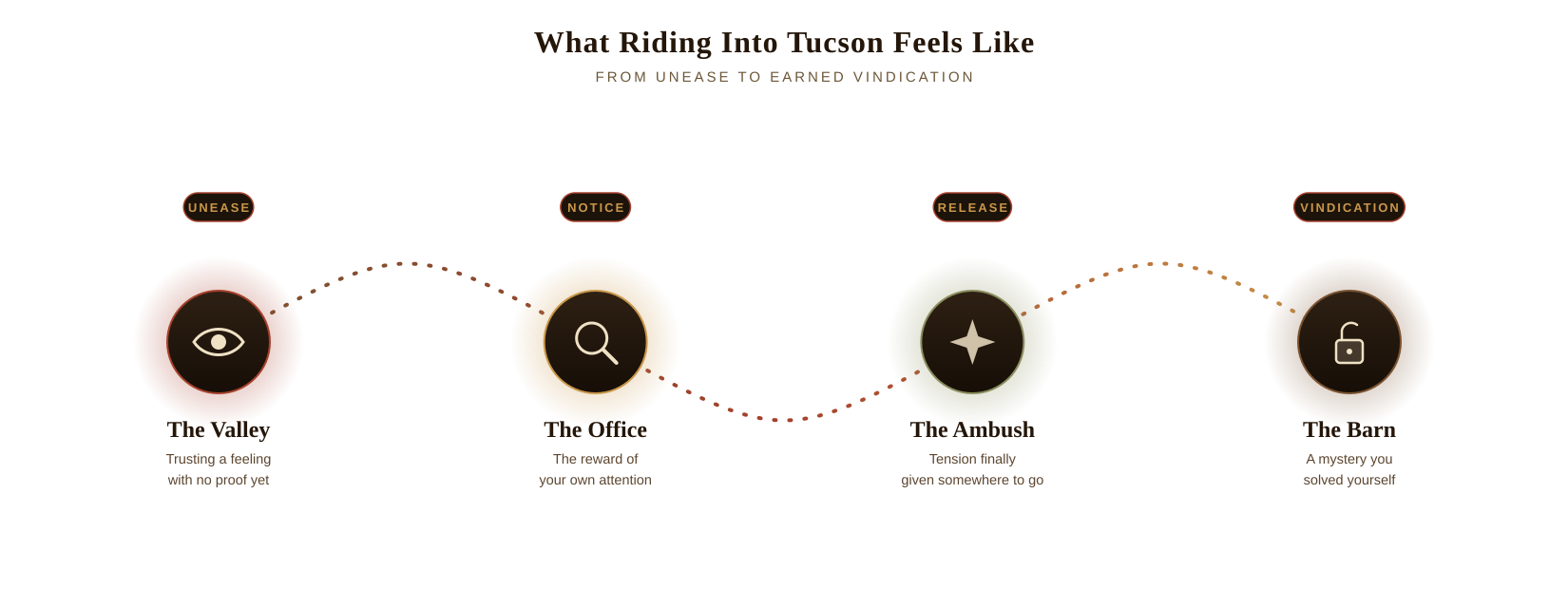
The opening stretch through the Valley of Despair gives the listener almost nothing concrete to react to – just heat, silence, and the sense of being watched by something that never quite steps into view. Most listeners describe this section as mildly uncomfortable at first, in the specific way that not knowing whether to be alert is more tiring than clear, confirmed danger would be. That discomfort is the point, not an oversight. It's training a muscle most daily life doesn't ask us to use much: sitting with a hunch instead of resolving it immediately, one way or the other, and trusting your own read on a situation before anyone else confirms it for you.
The night camp scene, where the fire is small and the dark presses in close and something watches from just past the light, tends to stick with listeners specifically because nothing happens. No attack, no reveal – just the discipline of not panicking, which turns out to be its own quiet kind of tension worth sitting inside.
The Sheriff's Office: The Pleasure of Noticing
This is the scene people bring up first, almost every time, and usually with a specific kind of enthusiasm. Nothing happens in it, technically – a room is examined, a desk, a report ledger. But listeners consistently describe a small jolt of satisfaction at spotting the wrong detail before the story confirms it: the dust that isn't where it should be, the coffee ring that's dry too fast for a room supposedly occupied that morning. That jolt is a specific, underused kind of pleasure – the reward of your own attention being correct – and it's rare enough in most adventure media that it stands out sharply here, more than any single action beat does.
The Town: Performing Calm Around a Stranger Who Notices
Walking through Tucson's streets and saloon, listeners often report an unusual, low-grade vigilance that lingers well after the scene ends – the same alertness you'd feel walking into a room where a conversation just stopped a half-beat too abruptly. It's a mild, entirely manageable version of social suspicion, and several listeners have described it as oddly clarifying rather than unpleasant: a reminder of how much real information sits in tone and timing, completely separate from what people actually choose to say out loud.

The Jail Cell: A Warning Left By Someone You'll Never Meet
The scratched marks on the cell door tend to land harder emotionally than any of the story's actual violence, which surprised us during development. Listeners describe a specific kind of chill that isn't about danger to themselves, but about recognizing a message clearly meant for exactly this moment – someone, at some point before the story even started, tried to warn whoever came next, with no guarantee anyone ever would. That's a different emotional register than fear. It's closer to solidarity with a stranger, reaching forward across time, inside a story that otherwise gives you very little direct human connection.
The Murder at Dawn: Knowing More Than the Town Around You
The shooting outside the post office is staged to be quick, clean, and almost anticlimactic in the moment – which is exactly what makes the aftermath so effective. As the town settles on the comfortable explanation of a distant gang, listeners who've been paying attention are left holding a very different, and much more uncomfortable, read on events. That gap – between what the town believes and what the listener has already pieced together – produces a genuinely unusual feeling: a kind of lonely certainty, being right about something in a room full of people who've decided on something easier to live with.
The Well: Patience Instead of Answers
The quiet scene with a young witness who says almost nothing consistently surprises listeners with how much it affects them, given how little actually happens in it. Because the story refuses to have her simply explain what she saw, listeners are left doing the same work the protagonist does – reading avoidance, silence, and what someone won't look at as a form of testimony. Several listeners have described this as the most emotionally affecting scene in the world, precisely because it asks for empathy rather than explanation.
The Ambush and the Sunset Attack: Earned, Not Ambient
Because the world spends so long building quiet suspicion, the two major action sequences – the sniper's ambush in the hidden rock basin, and the staged, coordinated attack at sunset – hit with unusual force when they finally arrive. Listeners consistently describe these scenes as more intense than comparable action beats in louder, more constantly violent media, and the likely reason is contrast: a nervous system that's been running on alert-but-unconfirmed for most of the experience finally gets an actual, unambiguous threat to respond to, and the release lands sharper for how long it was withheld. The two-word note found after the ambush – a deadline with no explanation attached – adds a specific, ticking-clock dread that several listeners single out as the moment the story stopped feeling like an investigation and started feeling like a race.

The Barn: Investigation Converting Into Consequence
Finding the missing sheriff alive, held but unbroken, tends to produce a specific mix of relief and vindication that listeners describe as more satisfying than a typical rescue scene, because by that point the listener has effectively solved part of the mystery themselves, well ahead of any character confirming it out loud. The story doesn't hand them the answer. It confirms one they'd already started to suspect several scenes earlier – which changes the rescue from a plot event delivered to the listener into something that feels closer to a personal payoff they helped earn.
Why Different Listeners Take Different Things From It
- Listeners who love classic Western atmosphere mostly talk about the world itself afterward – the heat, the dust, the specific, particular silence of the valley at night.
- Listeners drawn to historical texture focus on the physical detail – tack, boot prints, the geography of the frontier – the same way they'd appreciate a well-researched piece of historical fiction rewarding close attention.
- Listeners who came for a mystery talk almost exclusively about the three marks and the note, and the specific pleasure of watching a symbol they'd only half-understood finally click into place near the end.
- Listeners who just wanted an hour of tension and release tend to single out the sunset ambush as the moment the whole experience "paid off" – the exact instant all that withheld tension finally had somewhere to go.
Why "Chasing Gold" Still Hooks a Modern Listener
Tucson runs on suspicion, but it's worth naming the emotional register right next to it, because it's the one most people actually recognize fastest in themselves: obsession. Our source material's prospector storyline opens with a man admitting, almost reluctantly, that gold was never really just metal – it was a hunger strong enough to make him sell his old life and follow the rail line to the edge of the map. He notices the same restless fire in every stranger he meets: some talk about fortune with trembling excitement, others go quiet on the subject entirely, as if the land had already taken something from them.
That specific feeling – the invisible pull that outlasts the odds, the way hope and ruin end up standing side by side in the same conversation – turns out to be one of the most universally recognizable emotions we could build a world around, because almost nobody today has to imagine what it feels like anymore:
- Anyone who's watched a volatile stock or a coin chart at 2 a.m. knows the exact rhythm of hope outrunning judgment in real time.
- Anyone who's left a stable job to chase one big idea recognizes the fire the prospector sees in strangers' eyes – and the quiet ones who've already been burned by it.
- Anyone who's bought a lottery ticket "just this once" has felt the same brief, disproportionate surge of possibility a flash of color in a gold pan produces.
- Anyone who's kept refreshing a job application, a reply, a result knows what it's like to let a small, uncertain signal reorganize an entire evening.
A world built around this feeling doesn't need to explain obsession to a modern audience. It just needs to be honest about how it actually behaves – the way it convinces reasonable people to take unreasonable risks, one small hopeful signal at a time. Listening to that pull play out in someone else, at a safe distance, tends to be quietly clarifying about a person's own relationship to risk and hope – in a way a straightforward action story rarely manages.
Underneath the hat and the holster, Wild West is really offering a rehearsal in something most people don't get much practice with day to day: staying outwardly calm while internally certain something is wrong, and trusting that instinct long enough to gather actual proof instead of acting on it too soon. Almost nobody names that explicitly while listening. But it's the skill the whole hour is quietly built to exercise, scene after scene – and it's very likely the reason a mystery, more than a shootout, is what people remember most vividly once the story ends.